
Inventory is one of the most valuable assets for any business. Whether you operate a manufacturing plant, wholesale distribution center, retail warehouse, or logistics company, your ability to accurately manage inventory directly affects profitability, customer satisfaction, and operational efficiency.
Unfortunately, many businesses still rely on spreadsheets, paper-based records, or outdated software to manage warehouse inventory. As inventory volumes grow, these manual processes become increasingly difficult to maintain, leading to stock discrepancies, misplaced products, delayed shipments, and unnecessary operational costs.
A Warehouse Inventory Management System solves these challenges by providing businesses with real-time inventory visibility, automated stock tracking, and intelligent warehouse management tools.
Instead of manually updating stock records or searching for missing inventory, warehouse teams can monitor inventory movement from receiving through shipping using a centralized digital platform.
For Malaysian businesses embracing digital transformation and Industry 4.0 initiatives, implementing a Warehouse Inventory Management System is no longer just a technology upgrade. It has become a strategic investment that improves warehouse efficiency, reduces inventory losses, and supports long-term business growth.

In this guide, you’ll learn:
- What a Warehouse Inventory Management System is
- How it works
- Key features and benefits
- Inventory management best practices
- RFID integration
- Industries that benefit most
- How to choose the right inventory management solution in Malaysia
What is a Warehouse Inventory Management System?
A Warehouse Inventory Management System (WIMS) is software that enables businesses to monitor, control, and optimize inventory throughout the entire warehouse operation.
It records every inventory movement, from the moment products arrive at the warehouse until they are picked, packed, shipped, or returned.
Unlike manual inventory tracking, a Warehouse Inventory Management System continuously updates stock records in real time, giving warehouse managers complete visibility over inventory levels and product locations.
A modern inventory management system typically manages:
- Goods receiving
- Inventory storage
- Warehouse locations
- Inventory movement
- Stock replenishment
- Order picking
- Packing
- Shipping
- Returns processing
- Inventory reporting
By automating these processes, businesses reduce manual errors while improving operational efficiency and inventory accuracy.
Why Inventory Management Matters More Than Ever
Inventory management is no longer just about knowing how much stock is available.
Modern businesses must respond quickly to changing customer demand, shorter delivery times, and increasingly complex supply chains.
Poor inventory management often results in:
- Overstocking
- Stock shortages
- Lost inventory
- Duplicate purchases
- Delayed shipments
- Slow order fulfillment
- Higher storage costs
- Reduced customer satisfaction
These issues affect both profitability and business reputation.
An effective Warehouse Inventory Management System helps businesses eliminate these challenges through automation and real-time inventory control.
How a Warehouse Inventory Management System Works
Every inventory movement inside the warehouse follows a structured workflow.
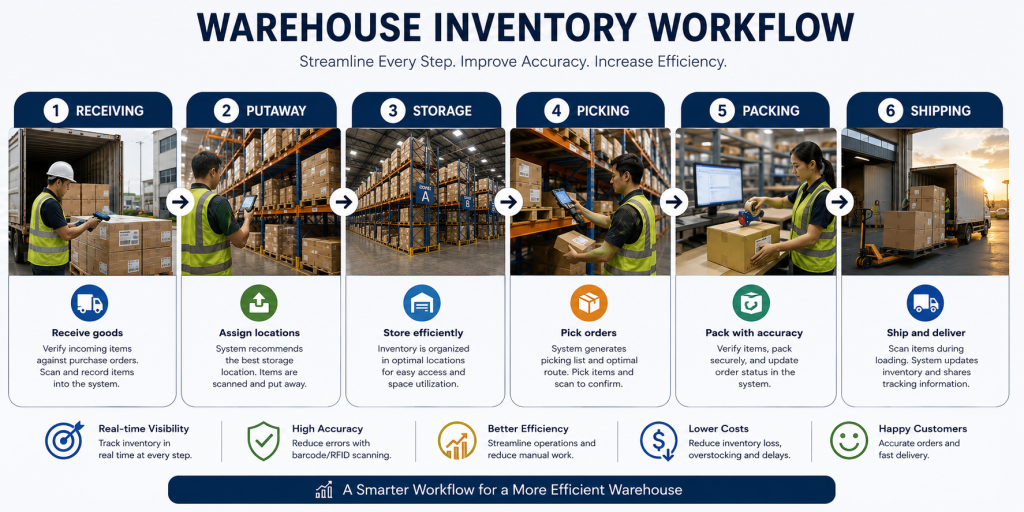
Step 1 – Receiving Inventory
Products arrive from suppliers and are verified against purchase orders.
Warehouse employees use barcode scanners or RFID readers to capture inventory information.
The system immediately records:
- Product details
- Quantity received
- Supplier information
- Receiving date
- Warehouse location
This eliminates manual data entry while improving receiving accuracy.
Step 2 – Putaway
After receiving, inventory is assigned to the most appropriate storage location.
The system recommends storage based on:
- Product category
- Inventory turnover
- Warehouse capacity
- Storage conditions
Organized putaway reduces travel time and improves warehouse efficiency.
Step 3 – Inventory Tracking
Once products are stored, every movement is automatically recorded.
Managers can instantly monitor:
- Available inventory
- Reserved inventory
- Inventory transfers
- Damaged products
- Product locations
- Warehouse capacity
Real-time tracking ensures inventory records remain accurate.
Step 4 – Order Picking
When customer orders are received, the system generates optimized picking routes.
Employees spend less time searching for products, allowing orders to be processed more quickly while reducing picking errors.
Step 5 – Packing and Shipping
Before shipment, inventory is verified using barcode or RFID technology.
Shipping documents and inventory records are updated automatically, ensuring accurate order fulfillment.
Step 6 – Reporting and Analytics
Managers can monitor warehouse performance through dashboards and reports that provide insights into inventory movement, warehouse productivity, and stock availability.
These reports support better planning and operational decision-making.
Key Features of a Warehouse Inventory Management System
A modern Warehouse Inventory Management System does much more than track stock quantities. It automates warehouse operations, improves inventory visibility, and provides real-time insights that help businesses make faster and more informed decisions.
When evaluating inventory management software, Malaysian businesses should look for the following essential features.
1. Real-Time Inventory Tracking
Real-time inventory tracking is the foundation of every successful warehouse operation.
Instead of waiting for manual stock counts, businesses can instantly view inventory levels, product locations, and stock movement across the warehouse.
Managers can monitor:
- Available inventory
- Reserved inventory
- Incoming stock
- Outgoing shipments
- Product locations
- Inventory history
Having access to accurate inventory data helps businesses avoid stock shortages, reduce excess inventory, and improve planning.
2. Intelligent Warehouse Location Management
Finding products quickly is essential for efficient warehouse operations.
A Warehouse Inventory Management System assigns inventory to optimized storage locations based on product demand, size, weight, or warehouse rules.
For example:
- Fast-moving products are stored closer to dispatch areas.
- Slow-moving inventory is placed in long-term storage.
- Fragile products are assigned to secure locations.
- Temperature-sensitive goods are stored in climate-controlled zones.
This organized storage strategy reduces employee travel time and increases picking efficiency.
3. Barcode and RFID Integration
Modern inventory management relies heavily on automation.
Warehouse Inventory Management Systems integrate with both barcode and RFID technologies to simplify inventory tracking.
Barcode Integration
Barcode scanners allow warehouse staff to quickly update inventory during:
- Receiving
- Putaway
- Picking
- Packing
- Shipping
RFID Integration
RFID technology automates inventory tracking by identifying multiple tagged products simultaneously without requiring direct line-of-sight scanning.
Benefits of RFID integration include:
- Faster inventory counting
- Higher inventory accuracy
- Reduced manual work
- Real-time warehouse visibility
- Improved stock traceability
Businesses managing large inventories often combine RFID with Warehouse Management Systems to create a highly automated warehouse environment.
4. Automated Stock Replenishment
Running out of inventory can result in delayed production and lost sales.
A Warehouse Inventory Management System automatically monitors inventory levels and alerts managers when stock reaches predefined reorder points.
This helps businesses:
- Prevent stock shortages
- Maintain optimal inventory levels
- Improve purchasing decisions
- Reduce emergency orders
Automated replenishment ensures inventory remains available without overstocking.
5. Order Fulfillment Management
Customer satisfaction depends on fast and accurate deliveries.
A Warehouse Inventory Management System streamlines the complete fulfillment process by managing:
- Order allocation
- Picking routes
- Packing verification
- Shipping confirmation
Warehouse teams process orders more efficiently while reducing shipping errors.
6. Reporting and Analytics
Modern inventory management software provides valuable business intelligence through real-time dashboards and detailed reports.
Managers can analyze:
- Inventory Accuracy
- Inventory Turnover
- Stock Ageing
- Warehouse Capacity
- Order Fulfillment Rate
- Picking Productivity
- Dead Stock
- Fast-Moving Products
These reports help businesses identify inefficiencies and improve warehouse performance continuously.
7. Multi-Warehouse Inventory Management
Businesses operating multiple warehouses require centralized inventory visibility.
A Warehouse Inventory Management System enables organizations to monitor inventory across multiple locations from a single dashboard.
Managers can:
- Transfer inventory between warehouses
- Monitor stock availability
- Balance inventory levels
- Improve replenishment planning
This centralized approach improves inventory control while supporting business expansion.
Benefits of Warehouse Inventory Management Software
Investing in Warehouse Inventory Management Software provides long-term operational and financial benefits.
Improved Inventory Accuracy
Inventory inaccuracies are one of the biggest causes of warehouse inefficiencies.
By automating inventory updates through barcode or RFID technology, businesses significantly reduce manual errors and maintain accurate stock records.
Accurate inventory improves purchasing decisions while reducing inventory losses.
Faster Warehouse Operations
Employees spend less time searching for products because every inventory location is digitally recorded.
Optimized warehouse workflows improve:
- Receiving speed
- Putaway efficiency
- Picking productivity
- Packing accuracy
- Shipping performance
As a result, warehouses process more orders without increasing labour costs.
Lower Operating Costs
Manual warehouse operations increase labour expenses and inventory carrying costs.
Automation reduces:
- Manual paperwork
- Inventory losses
- Duplicate purchasing
- Warehouse inefficiencies
- Overtime expenses
Lower operational costs contribute directly to higher profitability.
Better Inventory Visibility
Managers gain complete visibility over inventory movement across the warehouse.
This helps businesses:
- Improve inventory planning
- Reduce stock shortages
- Prevent overstocking
- Respond faster to customer demand
Inventory visibility is one of the biggest competitive advantages of modern warehouse management.
Better Customer Experience
Accurate inventory records ensure customers receive the correct products on time.
Benefits include:
- Faster deliveries
- Higher order accuracy
- Better stock availability
- Fewer customer complaints
Satisfied customers are more likely to become repeat buyers.
Business Scalability
As inventory volumes grow, manual inventory management becomes increasingly difficult.
A Warehouse Inventory Management System allows businesses to scale operations without significantly increasing administrative workload.
Whether expanding product lines or opening new warehouse locations, the system grows alongside the business.
Warehouse Inventory Management System vs Warehouse Management System
Many businesses use these terms interchangeably, but they are not exactly the same.
A Warehouse Inventory Management System focuses primarily on controlling inventory, monitoring stock levels, and improving inventory accuracy.
A Warehouse Management System (WMS) manages the entire warehouse operation, including inventory control, receiving, storage, picking, packing, shipping, labor management, and warehouse optimization.
| Feature | Warehouse Inventory Management System | Warehouse Management System |
|---|---|---|
| Inventory Tracking | ✔ | ✔ |
| Inventory Control | ✔ | ✔ |
| Warehouse Locations | ✔ | ✔ |
| Receiving Management | Limited | ✔ |
| Putaway Optimization | Limited | ✔ |
| Picking & Packing | Limited | ✔ |
| Shipping Management | Limited | ✔ |
| Labour Management | ✖ | ✔ |
| Warehouse Optimization | Limited | ✔ |
| Multi-Warehouse Support | ✔ | ✔ |
Businesses with smaller warehouse operations may find an Inventory Management System sufficient, while organizations handling complex warehouse processes often benefit from a full Warehouse Management System.
Warehouse Inventory Management vs ERP
Another common question is whether businesses need an ERP system or an Inventory Management System.
The answer depends on business requirements.
An ERP system manages company-wide functions such as:
- Finance
- Accounting
- Procurement
- Human Resources
- Sales
- Customer Management
A Warehouse Inventory Management System focuses specifically on inventory movement, warehouse operations, and stock control.
Many businesses integrate both systems to create a centralized operational platform where inventory, purchasing, sales, and finance remain synchronized.
RFID Integration with Warehouse Inventory Management
RFID technology has transformed inventory management by eliminating many of the limitations associated with manual stock tracking.
Instead of scanning products one by one, RFID automatically identifies multiple tagged items simultaneously.
When RFID is integrated with Warehouse Inventory Management Software, businesses gain:
- Real-time inventory visibility
- Faster inventory counts
- Higher inventory accuracy
- Automated stock movement tracking
- Reduced labour costs
- Better warehouse productivity
For manufacturers, logistics providers, distributors, and retailers in Malaysia, RFID integration provides a scalable solution that supports warehouse automation and digital transformation.
Industries That Benefit from a Warehouse Inventory Management System
Every business that stores, moves, or distributes inventory can benefit from a Warehouse Inventory Management System. While the operational requirements may vary from one industry to another, the goal remains the same: improve inventory accuracy, reduce manual work, and increase operational efficiency.
Manufacturing
Manufacturers deal with thousands of raw materials, components, work-in-progress items, and finished goods every day.
A Warehouse Inventory Management System helps manufacturers:
- Monitor raw material availability
- Prevent production delays
- Track inventory movement
- Reduce material wastage
- Improve production planning
For manufacturers adopting Industry 4.0 practices, inventory visibility is essential for maintaining efficient production lines.
Warehousing and Distribution
Distribution centres process large volumes of inventory daily.
A Warehouse Inventory Management System improves:
- Receiving operations
- Inventory organization
- Picking accuracy
- Shipping efficiency
- Warehouse space utilization
By automating inventory workflows, distribution centres can process more orders while reducing operating costs.
Retail and E-commerce
Retailers must maintain accurate inventory across physical stores and online sales channels.
An inventory management system enables businesses to:
- Prevent overselling
- Synchronize inventory
- Improve stock replenishment
- Process online orders faster
Real-time inventory updates improve customer satisfaction and reduce lost sales opportunities.
Logistics and Third-Party Logistics (3PL)
Logistics companies manage inventory for multiple clients simultaneously.
Inventory management software provides:
- Real-time shipment visibility
- Inventory traceability
- Warehouse coordination
- Faster order fulfillment
- Accurate customer reporting
This helps logistics providers deliver better service while improving warehouse productivity.
Food and Beverage
Food manufacturers and distributors must carefully manage product expiration dates and batch numbers.
Inventory management systems support:
- FIFO (First In, First Out)
- FEFO (First Expired, First Out)
- Batch tracking
- Lot traceability
These features help reduce waste while maintaining product quality and regulatory compliance.
Healthcare and Pharmaceuticals
Healthcare organizations require precise inventory control for medicines, surgical equipment, and medical supplies.
Warehouse Inventory Management Systems improve:
- Equipment tracking
- Medicine inventory
- Regulatory compliance
- Inventory availability
- Asset utilization
Accurate inventory management helps healthcare providers deliver better patient care.
Common Warehouse Inventory Challenges
Businesses often experience similar inventory management problems regardless of industry.
Some of the most common challenges include:
Inventory Inaccuracy
Manual stock updates often result in missing inventory, duplicate records, and incorrect stock balances.
Overstocking
Purchasing more inventory than required increases storage costs and ties up valuable working capital.
Stock Shortages
Running out of inventory delays customer orders and impacts production schedules.
Poor Warehouse Organization
Disorganized storage locations increase picking time and reduce employee productivity.
Manual Inventory Counting
Traditional inventory counting requires significant labour and often disrupts warehouse operations.
Limited Inventory Visibility
Without real-time inventory tracking, businesses struggle to make informed purchasing and operational decisions.
A modern Warehouse Inventory Management System eliminates these challenges through automation and real-time data collection.
Best Practices for Warehouse Inventory Management
Technology alone cannot guarantee warehouse success. Businesses should also adopt proven inventory management practices.
Some of the most effective strategies include:
- Perform regular cycle counting instead of relying solely on annual stock takes.
- Organize warehouse locations logically to reduce picking time.
- Implement barcode or RFID technology for automated inventory tracking.
- Define minimum and maximum stock levels.
- Monitor inventory turnover regularly.
- Remove obsolete or slow-moving inventory.
- Train warehouse employees on standardized inventory procedures.
- Continuously monitor warehouse KPIs.
Combining these practices with a Warehouse Inventory Management System creates a highly efficient warehouse operation.
How to Choose the Right Warehouse Inventory Management System
Choosing the right software requires careful planning.
Before selecting a solution, consider the following factors:
Scalability
Can the system support future business growth?
Integration
Can it integrate with:
- Warehouse Management Systems
- ERP Software
- Barcode Scanners
- RFID Technology
- Accounting Software
Ease of Use
A simple interface reduces employee training time and improves adoption.
Reporting
Look for software that provides real-time dashboards and customizable reports.
Vendor Support
Choose a provider offering:
- System implementation
- Staff training
- Technical support
- Future software upgrades
Working with an experienced local technology partner ensures smoother implementation and long-term success.
Warehouse Inventory Management System Implementation Process
A successful implementation follows a structured approach.
Step 1 – Analyze Warehouse Operations
Review existing inventory workflows and identify operational challenges.
Step 2 – Define Business Objectives
Set measurable goals such as:
- Improving inventory accuracy
- Reducing picking time
- Lowering operating costs
- Increasing warehouse productivity
Step 3 – Configure the System
Set up:
- Warehouse locations
- Inventory categories
- Barcode or RFID devices
- User permissions
Step 4 – Data Migration
Transfer inventory data from spreadsheets or legacy software into the new system.
Step 5 – Employee Training
Provide hands-on training so warehouse staff understand new workflows and system functionality.
Step 6 – Go Live
Launch the system while closely monitoring warehouse performance during the initial weeks.
Step 7 – Continuous Improvement
Regularly review reports and optimize warehouse processes based on operational data.
Warehouse KPIs Every Business Should Monitor
A Warehouse Inventory Management System provides valuable operational insights.
Important KPIs include:
- Inventory Accuracy
- Inventory Turnover
- Order Fulfillment Rate
- Order Cycle Time
- Picking Accuracy
- Warehouse Capacity Utilization
- Stock Availability
- Dead Stock Percentage
- Return Rate
- Labour Productivity
Tracking these KPIs helps businesses improve efficiency while reducing operational costs.
Frequently Asked Questions
What is a Warehouse Inventory Management System?
A Warehouse Inventory Management System is software that helps businesses track, control, and optimize inventory throughout warehouse operations.
Is Warehouse Inventory Management Software suitable for SMEs?
Yes. Modern cloud-based solutions are scalable and affordable, making them suitable for both small businesses and large enterprises.
What is the difference between Warehouse Management and Inventory Management?
Inventory Management focuses on stock control, while Warehouse Management covers the complete warehouse operation, including receiving, storage, picking, packing, shipping, and labour management.
Can Inventory Management Software integrate with RFID?
Yes. Modern inventory management systems integrate seamlessly with RFID technology to provide real-time inventory tracking and improved warehouse visibility.
Can Inventory Management Software integrate with ERP systems?
Yes. Most enterprise inventory management solutions integrate with ERP software to synchronize inventory, purchasing, sales, and accounting data.
How often should inventory be counted?
Many businesses now use cycle counting regularly instead of relying solely on annual physical inventory counts.
Is cloud-based inventory management better than on-premise software?
Cloud solutions provide lower upfront costs, remote access, automatic updates, and greater scalability. On-premise systems remain suitable for organizations requiring complete infrastructure control.
Which industries benefit most?
Manufacturing, logistics, retail, healthcare, food distribution, wholesale, automotive, and e-commerce businesses all benefit from Warehouse Inventory Management Systems.
Why Choose UID Solutions?
Managing warehouse inventory efficiently requires more than software. It requires a technology partner that understands warehouse operations, inventory control, and automation.
UID Solutions provides intelligent Warehouse Inventory Management Systems integrated with RFID, barcode technology, and Warehouse Management Software to help Malaysian businesses improve inventory accuracy and streamline warehouse operations.
Our solutions include:
- Warehouse Inventory Management Systems
- Warehouse Management Systems (WMS)
- RFID Inventory Tracking
- Barcode Solutions
- Asset Tracking Systems
- Inventory Automation
- ERP Integration
- System Implementation
- Staff Training
- Ongoing Technical Support
Whether you manage a manufacturing facility, warehouse, retail operation, or logistics centre, our experienced team delivers solutions tailored to your operational requirements and future business growth.
Final Thoughts
Managing warehouse inventory efficiently is essential for maintaining a competitive business. Manual inventory processes can no longer keep up with today’s fast-moving supply chains, increasing customer expectations, and growing warehouse complexity.
A modern Warehouse Inventory Management System provides businesses with the tools needed to automate inventory tracking, improve warehouse productivity, reduce operational costs, and make better business decisions through real-time visibility.
For organizations looking to modernize warehouse operations in Malaysia, investing in the right inventory management solution is not simply an operational improvement. It is a long-term investment in efficiency, accuracy, and sustainable business growth.
If you’re searching for a reliable Warehouse Inventory Management System in Malaysia, UID Solutions offers end-to-end inventory management, RFID integration, and warehouse automation solutions designed to help businesses transform the way they manage inventory.