
Malaysia’s logistics sector is evolving at an unprecedented pace. From the high-volume ports of Port Klang to the fast-growing industrial zones in Shah Alam and Johor Bahru, warehouses are under increasing pressure to modernize.
The surge in multi-channel e-commerce, combined with ongoing labor shortages, has exposed the limitations of manual inventory systems. Businesses relying on spreadsheets or outdated tools are now facing inefficiencies, stock inaccuracies, and missed revenue opportunities.
To remain competitive in 2026 and beyond, companies are rapidly adopting Warehouse Management System WMS software in Malaysia. But with a mix of global platforms and local providers available, choosing the right solution requires a clear understanding of market-specific needs.
Why Traditional WMS Systems Fail Malaysian Businesses
Many international WMS platforms are designed for Western markets and fail to address Malaysia’s operational realities. This mismatch leads to poor performance, higher costs, and limited scalability.
Key Challenges in Malaysia:
- High Humidity Conditions
Barcode labels degrade quickly, leading to scanning errors and operational delays. - Labor Dependency
Skilled warehouse workers are difficult to hire and retain, making automation essential. - Marketplace Integration Needs
Businesses require seamless syncing with platforms like Shopee, Lazada, and TikTok Shop to avoid overselling and inventory mismatches.
This is why Malaysian businesses need a localized, intelligent WMS solution built specifically for regional logistics demands.
Core Features of a High-Performance WMS in Malaysia
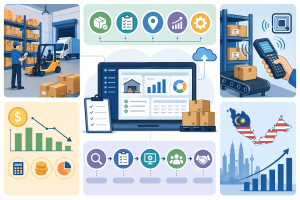
A modern WMS is no longer just an inventory tracker—it’s a central intelligence system for your entire supply chain.
1. Native RFID Integration (A Competitive Advantage)
Unlike legacy systems that treat RFID as an add-on, advanced WMS platforms integrate RFID at their core.
Key Benefits:
- Bulk Scanning: Instantly scan 500+ items without unpacking
- Touchless Inventory: Complete cycle counts in minutes
- 99.9% Accuracy: Eliminate manual errors
This dramatically improves warehouse speed, accuracy, and operational efficiency.
2. Multi-Channel Inventory Synchronization
Your WMS must act as a single source of truth across all sales channels.
Whether orders come from:
- Your website
- Physical retail stores
- Online marketplaces
Inventory updates should happen in real-time to prevent:
- Overselling
- Stock discrepancies
- Customer dissatisfaction
3. Intelligent Slotting & Smart Picking
Advanced WMS systems use data-driven algorithms to optimize warehouse layout.
How it helps:
- Places fast-moving products closer to picking zones
- Reduces worker travel time
- Increases order fulfillment speed
For large warehouses in Klang Valley, this can significantly boost productivity.
Cloud vs. On-Premise WMS: What’s Best for Malaysia in 2026?
Choosing between deployment models is critical for long-term success.
Cloud-Based WMS (SaaS)
- Low upfront cost
- Fast implementation (weeks)
- Automatic updates and maintenance
- Ideal for SMEs and e-commerce businesses
On-Premise WMS
- High initial investment
- Longer setup time
- Full control over data
- Suitable for government and high-security industries
Recommendation:
Most Malaysian SMEs benefit from cloud-based WMS solutions due to flexibility and scalability.
Industry Use Cases for WMS in Malaysia
E-commerce & Retail
Handle high-volume sales events like 11.11 and 12.12 without errors. Automate order processing and reduce fulfillment delays.
3PL (Third-Party Logistics)
Manage multiple clients efficiently with:
- Automated billing
- Dedicated dashboards
- Real-time reporting
Cold Chain & Healthcare
Ensure compliance with strict regulations by:
- Tracking expiry dates (FEFO method)
- Monitoring temperature-sensitive inventory
- Reducing spoilage and waste
Why Choose a Local WMS Provider in Malaysia?
While global platforms offer broad capabilities, local providers deliver market-specific advantages.
Key Benefits of a Local Partner:
- On-Site Implementation & Support
Hands-on assistance ensures smooth deployment and faster ROI - RFID Hardware + Software Expertise
Seamless integration without compatibility issues - Scalable Pricing Models
Affordable solutions designed for SMEs and growing enterprises
A local provider understands Malaysia’s logistics ecosystem better—giving your business a strategic edge.
The Future of Warehouse Management in Malaysia
By 2026, warehouses are no longer just storage facilities—they are data-driven logistics hubs.
Businesses adopting advanced WMS solutions benefit from:
- Real-time decision-making
- Predictive inventory management
- Reduced operational costs
- Improved customer satisfaction
Investing in the right WMS today ensures your business is future-proof, scalable, and competitive.
Frequently Asked Questions (FAQs)
1. What is the cost of WMS software in Malaysia (2026)?
- Cloud WMS: RM 1,500 – RM 6,000/month
- On-Premise WMS: RM 60,000 – RM 300,000+ upfront
Costs vary based on features, users, and integrations.
2. Can RFID be integrated with existing WMS?
Yes, but legacy systems often require costly middleware. Modern WMS solutions with native RFID integration eliminate this complexity and reduce costs.
3. How long does WMS implementation take?
- SMEs: 4–10 weeks
- Large enterprises: 4–6 months
Timeline depends on system complexity and warehouse size.
4. Is WMS suitable for small businesses?
Absolutely. With SaaS models, even businesses handling 500+ monthly orders can benefit from improved accuracy and efficiency.
5. Does WMS support Malaysia’s e-Invoicing (MyInvois)?
Yes. Modern WMS platforms integrate with LHDN systems to automatically generate and submit e-invoices during order fulfillment.
6. RFID vs. Barcodes: Which is better?
- Barcodes: Affordable but require line-of-sight scanning
- RFID: Faster, scalable, and ideal for high-volume operations
Best approach: Hybrid system (RFID for bulk, barcodes for individual items)
Conclusion: Upgrade Your Warehouse for 2026
The Malaysian logistics industry is moving toward automation, accuracy, and real-time intelligence. A modern WMS is no longer optional—it’s a necessity.
By adopting a system that combines RFID technology, smart automation, and local market compatibility, you position your business for long-term growth and operational excellence.
Ready to transform your warehouse operations?
Get a professional site audit and discover how an RFID-powered WMS can streamline your logistics, reduce costs, and maximize efficiency.