
Warehouses are no longer just storage facilities. They’ve become the operational backbone of manufacturers, distributors, retailers, and logistics companies across Malaysia. As customer expectations rise and supply chains grow more complex, businesses need faster, more accurate, and more efficient operations to stay competitive.
Yet many Malaysian companies still rely on manual tracking, spreadsheets, or outdated tools that can’t keep up with modern demand. The result: inventory discrepancies, delayed shipments, inefficient picking, and unnecessary costs.
This is where a warehouse management system (WMS) becomes essential — and where UID Solutions has spent nearly a decade helping local businesses close that gap.
In this guide, you’ll learn:
- What a WMS is and how it works
- Key features that actually move the needle
- WMS vs Inventory Management System vs ERP
- How RFID takes warehouse accuracy further
- How to choose the right fit for your business
- Real KPIs to track after go-live
What Is a Warehouse Management System?
A WMS is specialized software that manages, controls, and optimizes every warehouse activity from receiving incoming goods to shipping completed orders.
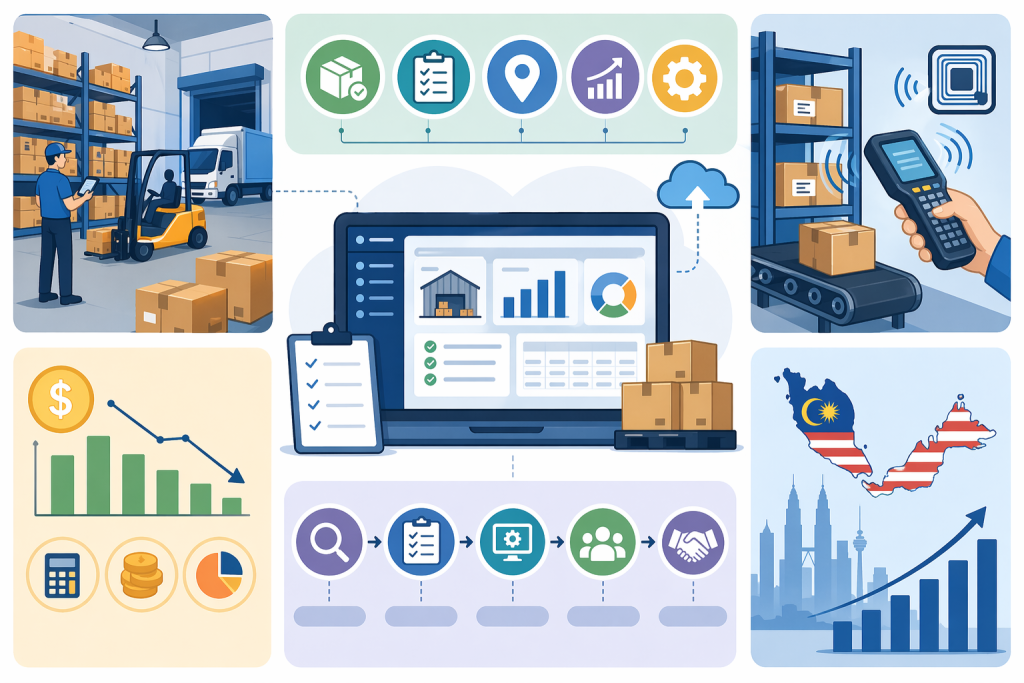
Unlike manual tracking, it gives businesses real-time visibility into inventory movement, capacity, staff productivity, and order fulfillment. Every movement is recorded automatically, giving managers full control without the paperwork.
A typical system manages:
- Receiving and putaway
- Storage location assignment
- Inventory tracking
- Picking, packing, and shipping
- Returns and reporting
- Demand forecasting
Think of it as the operating system running underneath your entire warehouse always tracking where products are, what’s available, and what needs to happen next.
See how this works in practice: our RFID-enabled WMS solutions
How Does It Work? A Step-by-Step Breakdown
- Receiving. Staff scan pallets or cartons on arrival using barcode or RFID readers. The system verifies purchase orders and updates stock instantly — no manual entry, far fewer receiving errors.
- Putaway. The software recommends the best storage location based on your rules — fast-movers near packing stations, slow-movers in long-term storage — cutting travel time.
- Real-time tracking. Managers see current stock, reserved inventory, damaged goods, and incoming/outgoing shipments from one screen at all times.
- Picking. Optimized picking routes replace manual searching, improving speed, accuracy, and staff productivity.
- Packing and shipping. Every order is verified via barcode or RFID before it leaves the building. Labels and documentation are generated automatically.
- Reporting. Dashboards track inventory accuracy, fulfillment rate, capacity utilization, and more — the data you need to spot bottlenecks before they cost you money.
Why Malaysian Businesses Are Investing Now
Malaysia is one of Southeast Asia’s fastest-growing manufacturing, logistics, and e-commerce hubs. As operations scale, manual inventory management becomes a real liability — inventory discrepancies, slow fulfillment during peak demand, overstocking, and rising labour costs are common pain points we hear from clients across Penang, Klang Valley, and Johor.
Businesses that modernize typically see higher accuracy, faster fulfillment, better organization, and lower operational costs — which is why this has shifted from a “nice to have” to a strategic investment for growth-stage companies.
For a deeper look at region-specific challenges, see our breakdown of Top 5 Warehouse Challenges in Klang Valley.
Key Features That Actually Matter
Not every system offers the same depth. Basic tools track inventory; the better ones automate the entire operation.
Real-time inventory visibility — One dashboard showing stock levels, locations, and shipments, so you can prevent shortages and overstocking before they happen.
Intelligent location management — Storage assignments based on product type, size, and pick frequency, minimizing staff travel time.
Barcode and RFID integration — Barcode scanning speeds up receiving and shipping; RFID goes further, identifying multiple tagged items without line-of-sight scanning. Together, they cut labour costs and boost accuracy significantly.
Curious how RFID compares to barcode for your operation? Read our RFID Inventory Management guide.
Smart picking and packing — Automatically generated routes based on warehouse layout, reducing errors and processing more orders per shift.
Performance reporting — Metrics like inventory turnover, capacity utilization, and shipping accuracy, so decisions are based on data, not guesswork.
Multi-warehouse management — A single platform to monitor stock, transfers, and replenishment across multiple locations.
Benefits Businesses Actually See After Implementation
- Higher inventory accuracy — fewer duplicate entries and misplaced stock
- Faster order fulfillment — streamlined receiving-to-shipping workflow
- Lower operating costs — less manual labour, fewer losses, better space use
- Better customer satisfaction — fewer shipping errors, faster delivery
- Improved productivity — staff spend less time correcting errors, more time on value-add work
- Scalability — add locations, users, and order volume without adding complexity
WMS vs Inventory Management System (IMS)
A common point of confusion. Both track stock — but scope is very different.
| Feature | WMS | IMS |
| Primary Focus | Full warehouse operations | Inventory quantity only |
| Receiving & Putaway | Yes | Limited |
| Warehouse Locations | Yes | No |
| Picking & Packing | Yes | Limited |
| Shipping Management | Yes | Limited |
| RFID Integration | Yes | Depends on system |
| Multi-Warehouse Support | Yes | Limited |
An IMS tracks how much stock you have. A WMS manages the entire physical operation around that stock — receiving, storage, labour, and fulfillment. For businesses running thousands of SKUs or multiple sites, that difference matters a lot.
For a full breakdown, see The Definitive Guide to WMS Software in Malaysia.
WMS vs ERP: Do You Need Both?
They solve different problems and usually work together. An ERP handles company-wide functions — finance, purchasing, HR. A WMS handles warehouse execution specifically. Many Malaysian businesses run both, integrated, so inventory, purchasing, and financial data stay in sync across the organization.
RFID + WMS: Where the Real Accuracy Gains Come From
Barcode scanning requires scanning items one at a time. RFID identifies multiple tagged items simultaneously, without direct line-of-sight — a meaningful speed and accuracy upgrade for businesses handling high SKU volumes.
Combined with a WMS, RFID enables real-time tracking, instant product location, reduced manual counting, and fewer inventory losses. At UID Solutions, RFID is built directly into our warehouse workflows — not bolted on — giving clients full supply chain visibility from day one.
Which Industries Benefit Most?
- Manufacturing — consistent raw material and finished goods availability
- Logistics & 3PL — accurate multi-client inventory tracking and reporting
- Retail & E-commerce — accurate stock levels during demand spikes, fewer overselling incidents
- Food & Beverage — FIFO/FEFO support for expiry and batch tracking
- Healthcare & Pharma — traceability and regulatory compliance
- Electronics & Automotive — RFID-based tracking for high-value inventory security
Cloud vs On-Premise: Which Fits Your Business?
| Feature | Cloud WMS | On-Premise WMS |
| Initial Investment | Lower | Higher |
| Deployment Time | Fast | Longer |
| Updates | Automatic | Manual |
| Remote Access | Yes | Limited |
| Best For | SMEs & growing businesses | Large enterprises with strict compliance needs |
Most Malaysian SMEs we work with choose cloud deployment for the lower upfront cost and remote accessibility. Larger enterprises with heavy customization or compliance requirements sometimes still prefer on-premise.
How to Choose the Right System
Before deciding, ask:
- Does it integrate with your existing ERP?
- Does it support barcode and RFID?
- Can it handle multiple warehouse locations?
- Will it scale as you grow?
- Does the vendor offer local implementation and support in Malaysia?
The technology partner matters as much as the software itself — local support significantly reduces implementation risk and speeds up time-to-value.
For real-world context on what this looks like from day one, see Warehouse Inventory Management: Everything Malaysian Businesses Need to Know.
Best Practices for a Smooth Rollout
- Audit existing workflows before configuring anything
- Define clear, measurable objectives
- Clean up inventory data before migration
- Configure warehouse zones and locations
- Integrate barcode/RFID hardware
- Train staff thoroughly — adoption is the #1 failure point
- Test end-to-end before go-live
- Monitor KPIs and optimize continuously
KPIs to Track After Go-Live
Inventory Accuracy Rate · Order Fulfillment Rate · Picking Accuracy · Inventory Turnover · Warehouse Capacity Utilization · Order Cycle Time · Shipping Accuracy · Labour Productivity
Frequently Asked Questions
What is a warehouse management system? Software that manages inventory, receiving, storage, picking, packing, and shipping from one centralized platform.
How is it different from an inventory management system? An IMS tracks stock quantities. A WMS manages the full physical warehouse operation around that stock.
Is it suitable for small businesses? Yes — cloud-based systems scale to fit smaller operations without heavy upfront investment.
Does it work with RFID? Yes, most modern systems support RFID for real-time tracking and automated stock updates.
How long does implementation take? Small projects: a few weeks. Enterprise deployments: several months, depending on scope.
Is cloud better than on-premise? For most SMEs, yes — lower cost and remote access. Large enterprises with compliance needs may prefer on-premise.
Why Malaysian Businesses Choose UID Solutions
We’re not a generic software reseller — we build and implement RFID-integrated warehouse systems specifically for Malaysian manufacturers, distributors, and logistics providers. Our team handles local implementation and support directly, which means faster go-live and fewer surprises during rollout.
Whether you’re upgrading an existing setup or implementing a WMS for the first time, our team works with you to build a solution around your actual operation — not a one-size-fits-all package.