
Businesses across Malaysia are rapidly adopting digital technologies to improve operational efficiency, reduce manual work, and gain better control over inventory and assets. Whether it’s a manufacturing facility, distribution centre, retail chain, healthcare institution, or logistics company, accurate tracking of products and assets has become essential for staying competitive.
Traditional barcode systems have helped businesses manage inventory for years, but modern supply chains demand faster, more intelligent solutions. Companies now require real-time visibility, automated inventory updates, and accurate tracking across multiple warehouse locations.
This is where Radio Frequency Identification (RFID) technology makes a significant difference.
An RFID system allows businesses to automatically identify, track, and monitor products, pallets, equipment, and assets without manual scanning. Combined with Warehouse Management Systems (WMS) and Enterprise Resource Planning (ERP) software, RFID creates a highly automated environment that improves inventory accuracy while reducing operational costs.
As demand for warehouse automation continues to grow, choosing the right RFID solution provider in Malaysia becomes just as important as selecting the technology itself.
In this guide, you’ll learn:
- What RFID is and how it works
- Components of an RFID system
- Benefits of RFID technology
- Industries using RFID in Malaysia
- How to choose the right RFID company
- RFID vs Barcode comparison
- Why businesses trust UID Solutions for RFID implementation
What is RFID?
RFID (Radio Frequency Identification) is a wireless technology that uses radio waves to identify and track tagged objects automatically.
Unlike traditional barcode systems, RFID does not require direct line-of-sight scanning. Instead, RFID readers communicate with RFID tags through radio signals, allowing multiple items to be detected simultaneously.
Every RFID tag contains a unique identification number that is linked to a product, pallet, container, or business asset. As tagged items move throughout a warehouse or facility, RFID readers automatically capture their information and update the inventory management system in real time.
Because this process is automated, businesses gain better visibility over inventory movement while significantly reducing manual work.
Today, RFID technology is widely used across manufacturing, logistics, warehousing, retail, healthcare, automotive, and government sectors throughout Malaysia.
How Does RFID Technology Work?
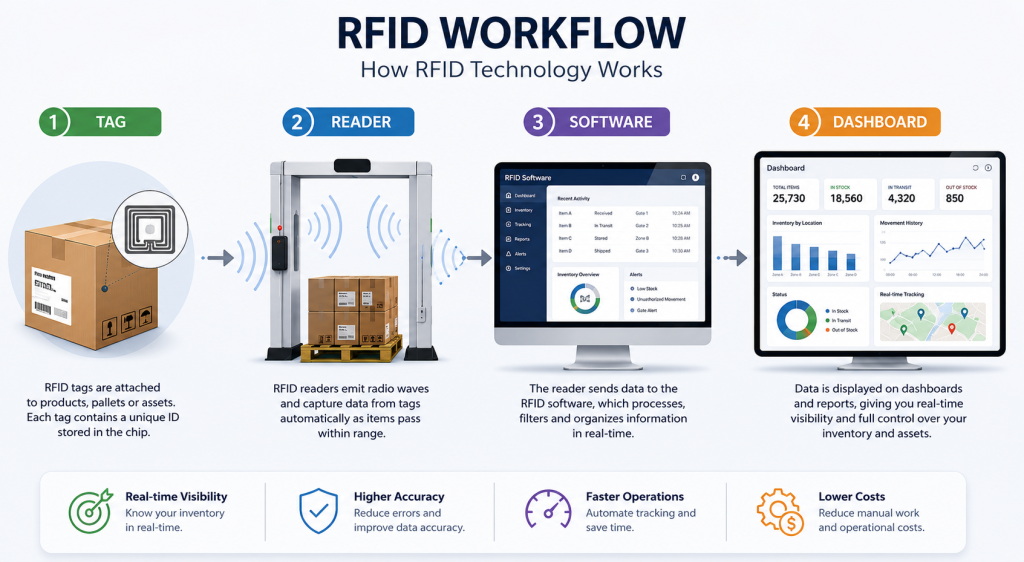
Although RFID technology appears sophisticated, its operation follows a simple and highly efficient process.
Step 1: RFID Tags Are Attached
Every product, carton, pallet, or asset receives an RFID tag containing a unique electronic identifier.
These tags can be attached to:
- Finished products
- Inventory cartons
- Warehouse pallets
- Returnable containers
- Company assets
- Vehicles
- Equipment
Unlike printed barcodes, RFID tags can store additional information and be updated throughout the product lifecycle.
Step 2: RFID Readers Detect Tagged Items
As inventory moves through receiving docks, warehouse aisles, production lines, or shipping areas, RFID readers automatically detect nearby tags.
Employees no longer need to scan every individual item manually.
Multiple products can be identified within seconds, improving warehouse productivity and reducing labour requirements.
Step 3: Information Is Sent to RFID Software
The RFID reader transfers collected data to the RFID management software or Warehouse Management System.
The software automatically records:
- Product identification
- Inventory quantity
- Warehouse location
- Date and time
- Movement history
Managers receive live inventory updates without manual data entry.
Step 4: Real-Time Visibility
Because inventory information is updated automatically, warehouse managers always know:
- What inventory is available
- Where products are located
- Which assets are moving
- Which inventory requires replenishment
- Which products have already been shipped
This level of visibility significantly improves operational decision-making.
Components of an RFID System
A successful RFID solution consists of several integrated components working together.
RFID Tags
RFID tags are attached directly to inventory or assets.
Each tag contains a microchip and antenna that stores a unique electronic identification number.
Depending on business requirements, RFID tags may be:
- Passive RFID Tags
- Active RFID Tags
- Semi-Passive RFID Tags
Passive tags are the most commonly used because they are affordable and require no internal power source.
RFID Readers
RFID readers communicate with RFID tags using radio frequency signals.
Readers can be installed in various locations, including:
- Warehouse entrances
- Loading bays
- Conveyor systems
- Production lines
- Retail stores
- Vehicle checkpoints
They automatically capture inventory movement without interrupting warehouse operations.
RFID Antennas
RFID antennas transmit and receive radio signals between RFID tags and RFID readers.
The number and placement of antennas determine system coverage and reading accuracy.
Proper antenna positioning is essential for achieving reliable RFID performance.
RFID Software
The software serves as the intelligence behind the RFID solution.
It collects information from RFID readers and converts raw data into meaningful business insights.
Modern RFID software integrates with:
- Warehouse Management Systems (WMS)
- Enterprise Resource Planning (ERP)
- Inventory Management Systems
- Asset Tracking Platforms
- Business Intelligence Dashboards
This integration enables businesses to manage inventory and assets from a centralized platform.
Benefits of RFID Solutions for Modern Businesses
As businesses grow, manual inventory tracking becomes increasingly difficult. Inventory errors, misplaced products, delayed shipments, and inaccurate stock records can slow down operations and increase operational costs.
RFID technology addresses these challenges by automating inventory management and providing real-time visibility across the entire supply chain.
Below are some of the biggest benefits businesses experience after implementing an RFID solution.
1. Real-Time Inventory Visibility
One of the biggest advantages of RFID technology is complete inventory transparency.
Instead of waiting for manual stock counts, businesses can instantly see where every tagged product or asset is located.
Managers can monitor:
- Current inventory levels
- Product locations
- Warehouse movements
- Incoming shipments
- Outgoing deliveries
- Inventory history
Real-time visibility enables faster decision-making while reducing inventory discrepancies.
2. Improved Inventory Accuracy
Manual inventory management often results in duplicate entries, missing stock, or incorrect inventory records.
RFID automatically updates inventory whenever tagged products move through receiving, storage, production, or shipping areas.
As a result, businesses experience:
- Higher inventory accuracy
- Fewer stock discrepancies
- Reduced inventory losses
- Better warehouse organization
For companies managing thousands of SKUs, even small improvements in inventory accuracy can lead to significant cost savings.
3. Faster Inventory Counting
Traditional inventory audits require employees to scan each product individually.
With RFID, hundreds of tagged items can be identified simultaneously.
This allows businesses to:
- Complete inventory counts much faster
- Reduce warehouse downtime
- Eliminate repetitive manual scanning
- Improve productivity
Many organizations that switch from barcode scanning to RFID reduce inventory counting time from several days to just a few hours.
4. Better Warehouse Productivity
Warehouse employees spend less time searching for inventory and more time completing value-added tasks.
Automated tracking improves:
- Receiving efficiency
- Putaway operations
- Picking accuracy
- Packing speed
- Shipping performance
The result is a more productive warehouse with lower operating costs.
5. Reduced Human Error
Manual data entry is one of the leading causes of inventory inaccuracies.
RFID minimizes human intervention by automatically recording inventory movements.
This significantly reduces:
- Incorrect stock updates
- Shipping errors
- Duplicate inventory records
- Lost products
Greater automation leads to more reliable warehouse operations.
6. Better Customer Satisfaction
Accurate inventory and faster order fulfillment improve the customer experience.
Businesses can deliver:
- Faster shipping
- Accurate orders
- Better product availability
- Reliable delivery schedules
Satisfied customers are more likely to place repeat orders and recommend your business.
Industries Using RFID in Malaysia
RFID technology is now used across almost every major industry in Malaysia. As businesses continue adopting Industry 4.0 initiatives, RFID has become an essential tool for improving operational efficiency and inventory visibility.
Manufacturing
Manufacturers use RFID to monitor raw materials, production inventory, and finished goods throughout the manufacturing process.
Benefits include:
- Material traceability
- Production tracking
- Reduced inventory losses
- Faster production planning
Warehousing and Distribution
Warehouse operators rely on RFID to improve inventory accuracy and automate warehouse processes.
Common RFID applications include:
- Receiving inventory
- Putaway management
- Inventory tracking
- Cycle counting
- Order fulfillment
- Shipping verification
Combined with a Warehouse Management System, RFID enables highly efficient warehouse operations.
Logistics and Supply Chain
Logistics companies manage thousands of shipments every day.
RFID helps improve:
- Shipment visibility
- Container tracking
- Fleet operations
- Cross-docking
- Delivery accuracy
This reduces delays while improving customer satisfaction.
Retail
Retail businesses use RFID to maintain accurate inventory across stores and warehouses.
Retailers benefit from:
- Faster stock replenishment
- Reduced stockouts
- Improved inventory accuracy
- Better loss prevention
Healthcare
Hospitals and healthcare providers use RFID to monitor:
- Medical equipment
- Pharmaceuticals
- Patient assets
- Laboratory inventory
This improves asset utilization while ensuring critical equipment remains available.
Automotive and Electronics
High-value products require accurate tracking throughout manufacturing and distribution.
RFID enables:
- Component traceability
- Finished product tracking
- Inventory visibility
- Supply chain transparency
Top RFID Solution Providers in Malaysia
Malaysia has a growing number of companies offering RFID hardware, software, and system integration services. Choosing the right partner depends on your industry, business size, and operational requirements.
Below are some of the well-known RFID solution providers serving Malaysian businesses.
1. UID Solutions
UID Solutions specializes in end-to-end RFID and warehouse automation solutions for businesses looking to improve inventory visibility and operational efficiency.
Their solutions include:
- RFID Inventory Management
- Warehouse Management Systems (WMS)
- Asset Tracking Systems
- Barcode Solutions
- Inventory Automation
- Warehouse Digitalization
- RFID System Integration
By combining RFID technology with Warehouse Management Software, UID Solutions helps manufacturers, distributors, retailers, and logistics companies reduce manual processes while improving inventory accuracy and warehouse performance.
2. Zebra Technologies
Zebra Technologies is a globally recognized provider of barcode scanners, RFID readers, mobile computers, and warehouse automation solutions used across manufacturing, retail, and logistics industries.
3. Honeywell
Honeywell offers industrial mobility solutions, barcode scanners, RFID hardware, warehouse software, and automation technologies for enterprise businesses.
4. Impinj
Impinj focuses on RFID chips, readers, gateways, and IoT connectivity solutions that support large-scale inventory tracking and supply chain visibility.
5. Avery Dennison
Avery Dennison supplies RFID labels, tags, and intelligent packaging solutions for retail, manufacturing, and logistics businesses.
RFID vs Barcode: Which Technology Is Better?
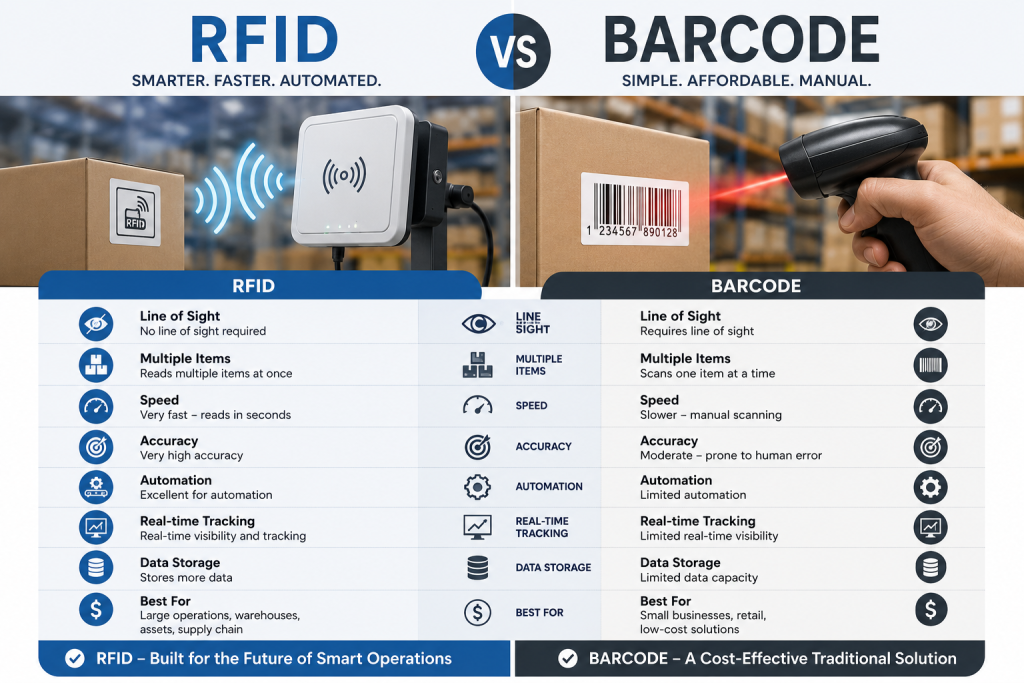
Many businesses wonder whether they should continue using barcode technology or upgrade to RFID.
Both technologies improve inventory management, but they serve different operational needs.
| Feature | RFID | Barcode |
|---|---|---|
| Line of Sight Required | No | Yes |
| Scan Multiple Items | Yes | No |
| Reading Speed | Very Fast | Manual |
| Inventory Accuracy | Very High | High |
| Automation Level | Excellent | Moderate |
| Real-Time Tracking | Yes | Limited |
| Initial Investment | Higher | Lower |
Barcode systems remain suitable for small businesses with lower inventory volumes.
However, companies managing large warehouses, multiple locations, or high-value inventory often benefit more from RFID because of its automation capabilities and real-time tracking.
RFID Inventory Management
Inventory accuracy is one of the primary reasons businesses invest in RFID technology.
An RFID Inventory Management System continuously tracks inventory movement throughout the warehouse without requiring manual scanning.
Businesses gain complete visibility over:
- Inventory availability
- Product locations
- Warehouse transfers
- Receiving operations
- Shipping activities
- Inventory history
This enables faster inventory audits, fewer stock discrepancies, and improved warehouse performance.
RFID Warehouse Solutions
Modern warehouse operations demand speed, accuracy, and automation.
RFID Warehouse Solutions integrate seamlessly with Warehouse Management Systems to automate inventory tracking from receiving through shipping.
Businesses implementing RFID warehouse solutions often experience:
- Faster warehouse operations
- Reduced labour requirements
- Improved inventory accuracy
- Better order fulfillment
- Lower operating costs
- Increased warehouse productivity
For growing Malaysian businesses, RFID provides a scalable foundation for future warehouse automation initiatives.
How to Choose the Right RFID Solution Provider in Malaysia
Choosing an RFID solution provider is about more than purchasing hardware. The right partner should understand your business processes, warehouse operations, and long-term growth plans.
Before investing in an RFID system, evaluate the following factors.
Industry Experience
Different industries have different operational requirements.
For example:
- Manufacturing companies require production traceability.
- Warehouses focus on inventory visibility.
- Retail businesses need accurate stock replenishment.
- Healthcare organizations prioritize asset and equipment tracking.
Choose a provider with proven experience in your industry rather than a generic technology vendor.
End-to-End Solution Capabilities
Many companies only supply RFID tags or readers.
A reliable RFID partner should deliver a complete solution, including:
- RFID Tags
- RFID Readers
- RFID Antennas
- RFID Software
- Warehouse Management System Integration
- ERP Integration
- Installation
- Staff Training
- Technical Support
Working with one implementation partner simplifies deployment and ongoing maintenance.
System Integration
Your RFID solution should integrate seamlessly with your existing business software.
Look for compatibility with:
- Warehouse Management Systems (WMS)
- ERP Systems
- Inventory Management Software
- Barcode Systems
- Business Intelligence Platforms
Integrated systems eliminate duplicate data entry and improve operational visibility.
Scalability
Your business will continue to grow.
Choose an RFID solution that can support:
- Additional warehouse locations
- More users
- Larger inventory volumes
- Additional RFID readers
- Future automation initiatives
A scalable system protects your investment and reduces future implementation costs.
Local Technical Support
Implementation is only the beginning.
Reliable technical support ensures:
- Faster issue resolution
- Regular software updates
- Hardware maintenance
- Staff retraining
- Future system enhancements
A provider with a local presence in Malaysia can respond more quickly whenever support is required.
RFID Implementation Process
Successful RFID deployment requires careful planning rather than simply installing readers and attaching tags.
Most implementations follow these stages.
Step 1 – Business Process Analysis
The implementation team studies existing warehouse workflows, inventory processes, and operational challenges.
This helps determine where RFID will deliver the greatest business value.
Step 2 – Site Survey
Warehouse layouts are evaluated to identify optimal locations for:
- RFID Readers
- RFID Gates
- Antennas
- Mobile Devices
Proper planning minimizes reading errors and ensures consistent system performance.
Step 3 – Hardware Installation
The RFID infrastructure is installed, including:
- Fixed Readers
- Handheld Readers
- RFID Gates
- Antennas
- Network Equipment
Step 4 – Software Integration
The RFID platform is connected with:
- Warehouse Management System
- ERP Software
- Inventory Management System
- Business Database
This enables automatic inventory synchronization across the organization.
Step 5 – Testing and Training
Before going live, businesses perform:
- User Acceptance Testing (UAT)
- Read Accuracy Testing
- Workflow Validation
- Employee Training
Proper training ensures warehouse staff can confidently use the new system from day one.
Step 6 – Go Live and Continuous Optimization
Once the system is live, businesses monitor performance, identify improvement opportunities, and expand RFID coverage as operations grow.
Continuous optimization helps maximize return on investment.
RFID Implementation Cost in Malaysia
One of the most common questions businesses ask is:
“How much does an RFID system cost?”
The answer depends on several factors, including warehouse size, infrastructure, and operational complexity.
Typical cost factors include:
- Number of RFID tags
- Type of RFID readers
- Number of warehouse entry points
- Software licensing
- ERP or WMS integration
- Installation and configuration
- Employee training
- Ongoing maintenance
Instead of focusing solely on upfront costs, businesses should evaluate the long-term value of RFID through improved inventory accuracy, lower labour costs, reduced stock losses, and faster warehouse operations.
A well-planned RFID implementation often delivers measurable returns by increasing operational efficiency and reducing manual processes.
Frequently Asked Questions
What is RFID?
RFID (Radio Frequency Identification) is a wireless technology that automatically identifies and tracks products or assets using radio waves instead of manual scanning.
What industries use RFID in Malaysia?
RFID is widely used across manufacturing, warehousing, logistics, retail, healthcare, automotive, education, and government sectors.
Is RFID better than barcode?
RFID offers faster scanning, real-time tracking, and the ability to identify multiple items simultaneously. Barcode systems remain cost-effective for smaller operations but require manual scanning.
Can RFID integrate with Warehouse Management Systems?
Yes. Most modern RFID solutions integrate with Warehouse Management Systems (WMS), ERP software, inventory management systems, and business intelligence platforms.
How accurate is RFID technology?
When properly implemented, RFID systems can achieve inventory accuracy levels above 99%, significantly reducing manual counting errors and stock discrepancies.
How long does RFID implementation take?
Implementation timelines vary depending on project size. Small warehouse deployments may take a few weeks, while enterprise implementations can take several months.
What is the difference between passive and active RFID tags?
Passive RFID tags do not contain an internal battery and are activated by RFID readers. Active RFID tags have their own power source, allowing them to transmit signals over longer distances.
Is RFID suitable for small businesses?
Yes. Many cloud-based RFID solutions are scalable and can support both SMEs and large enterprises. Businesses can start with a smaller deployment and expand as operational needs grow.
Can RFID reduce warehouse operating costs?
Yes. RFID reduces manual labour, improves inventory accuracy, speeds up warehouse operations, and minimizes inventory losses, helping businesses lower operating costs over time.
Why should businesses choose a local RFID solution provider?
A local implementation partner understands regional business requirements, provides faster technical support, and offers on-site assistance during implementation and system maintenance.
Why Choose UID Solutions?
Implementing RFID technology successfully requires more than hardware. It requires a partner that understands warehouse operations, inventory management, and digital transformation.
UID Solutions delivers end-to-end RFID solutions designed specifically for Malaysian businesses. From system design and hardware deployment to software integration and ongoing support, we help organizations modernize operations while improving inventory visibility and warehouse efficiency.
Our RFID capabilities include:
- RFID Inventory Management
- Warehouse Management System Integration
- Asset Tracking Solutions
- Barcode System Integration
- Warehouse Automation
- Inventory Visibility
- ERP Integration
- Technical Consultation
- Implementation & Training
- After-Sales Support
Whether you’re managing a manufacturing facility, logistics hub, retail warehouse, or distribution center, our team works closely with you to develop an RFID solution that aligns with your operational goals and future growth.
Final Thoughts
As Malaysian businesses continue embracing automation and Industry 4.0 technologies, RFID has become a key driver of operational efficiency. From inventory management and warehouse automation to asset tracking and supply chain visibility, RFID enables organizations to work smarter, reduce manual processes, and make better business decisions.
Choosing the right RFID solution provider is just as important as selecting the technology itself. A reliable partner will help you design, implement, integrate, and optimize a solution that delivers long-term value.
If you’re looking for a trusted RFID solution provider in Malaysia, UID Solutions offers comprehensive RFID systems, Warehouse Management System integration, barcode solutions, and inventory automation services tailored to your business. Contact our team today to discover how RFID can transform your warehouse and supply chain operations.